The audio controls above still work. Interactive translation, saving and practice need JavaScript. You can read the complete transcript and download your study materials below.
Complete English transcript
Part One The Mystery of the Two Minds Have you ever walked into a kitchen, looked at the fridge, and completely forgotten why you went there in the first place?
Or perhaps you have made a quick emotional purchase online that felt right at the moment, but an hour later you realized it was a total mistake.
We often think we are the absolute masters of our own thoughts and that every choice we make is based on cold, hard
logic.
But what if I told you that most of your life is actually run by a fast, emotional, and often invisible autopilot?
Welcome to Your English Toolbox, your slow English podcast where we train your ears step by step.
I am Martin and I am Julia.
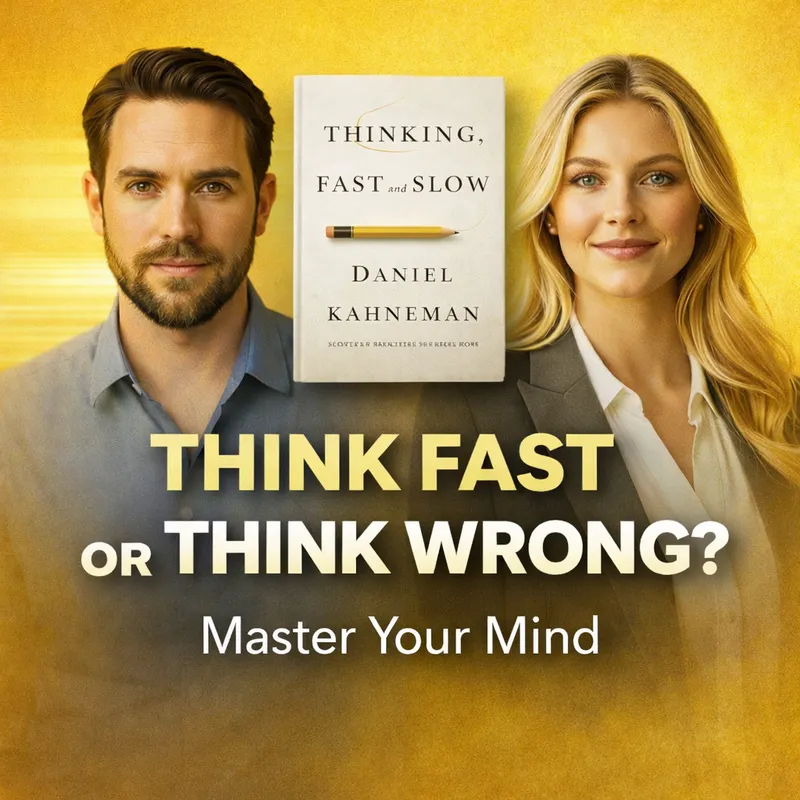
Julia, today we are exploring a masterpiece of psychology, Thinking Fast and Slow by the Nobel Prize winner Daniel Kahneman.
This is such a fundamental book for anyone interested in personal growth because
understanding how we think is the first step to thinking better.
In this episode, we will reveal the two characters that control your brain, explain why your intuition can sometimes be your worst enemy, and show you how to slow down your thinking to achieve better results in life and in English.
If you stay with us until the end, you will learn how to identify mental traps before they happen, you will improve your English vocabulary for psychology, and
you will discover a secret to making more confident decisions in your daily life.
Part Two Meeting the Fast and the Slow Imagine your brain is like a large company with two very different employees working in the same small office.
That is a great way to visualize it.
Who are these employees and why don't they get along?
The first employee is what Kahneman calls System One.
He is incredibly fast, he never sleeps, and he makes decisions in
a fraction of a second without you even noticing.
He is the one who handles the easy things, right?
Exactly.
When you see that two plus two equals four, that is System One providing the answer instantly.
When you read a person's facial expression and know they are angry before they open their mouth, that is also System One.
So System One is our intuition, our habits, and our survival instinct all rolled into one.
Yes, but the problem is
that System One loves to jump to conclusions, and it hates being confused.
And that is where the second employee comes in to save the day.
Precisely.
System Two is the slow, logical, and hard-working part of your brain.
He is the one you use when you are trying to learn a complex new grammar rule or calculate a difficult tip at a restaurant in a foreign currency.
But there is a major catch with System Two, isn't there?
There
is.
System Two is what we call lazy.
Wait.
Lazy is a very strong word to use for our logical mind.
It sounds like you are saying our brain prefers not to work hard if it can avoid it.
That is exactly what the research suggests.
Thinking deeply takes a huge amount of physical energy.
It actually burns calories and makes your pupils dilate.
So our brain tries to conserve energy by letting System One handle almost everything on autopilot.
Exactly.
We think we are making logical choices, but often we are just following the first fast thought that pops into our heads because System Two was too tired to check the facts.
One of the most fascinating and dangerous things System One does is create stories to explain the world.
We are natural storytellers, aren't we?
It helps us make sense of the chaos.
We are, but System One wants the story to be coherent and simple more than
it wants the story to be true.
Kahneman has a special acronym for this.
W-Y-S-I-A-T-I.
That sounds like a strange word.
What does it stand for in plain English?
It stands for what you see is all there is.
It means our brain takes the tiny amount of information we have and builds a complete certain picture of reality, ignoring everything we don't know.
For example, if I meet a new person and they are wearing a very expensive suit,
my System One might decide they are very intelligent and successful.
Exactly.
That is a classic example of the halo effect.
I can see how this is a huge trap for English learners.
Their System One creates a story of inferiority that can be very damaging to their confidence.
They would realize that speaking fast is just a habit, not a measure of intelligence.
Yes, but System Two is often taking a nap, so it just accepts the fast story
from System One without questioning it.
Let's talk about another trick our brain plays that marketers love to use.
Anchoring.
I have heard of this in business negotiations.
It is about the first number mentioned, right?
Exactly.
Kahneman showed that the first piece of information we receive acts like a heavy anchor in our minds.
If you walk into a boutique and see a watch that costs $2,000 and then you see one for $500, the second one feels like
a massive bargain.
But if you had seen a $50 watch first, the $500 one would seem incredibly expensive and overpriced.
Our brain doesn't look at the absolute value of the object.
It only looks at the relative value compared to that first anchor.
So our environment is constantly priming our brains to think in certain ways without us even realizing it.
It is happening every single second.
The words we hear, the music in a shop, even the temperature
of the room can pull our anchors in different directions.
This is why it is so important to be intentional about the English environment we create for ourselves.
If you only listen to news reports about how difficult and impossible English is, your anchor for your own potential will be very low and you will feel like you are failing because your brain has accepted a negative anchor as the truth.
That is a very powerful point, Julia.
By slowing
down and choosing slow English, you are setting a new realistic and positive anchor for your brain.
It allows System 2 to feel comfortable and safe instead of constantly stressed by high pressure anchors.
Part 5.
Loss Aversion.
Why we fear change.
Now we come to perhaps the most famous discovery in the book.
Loss Aversion.
This is the idea that the pain of losing is much stronger than the joy of gaining, isn't it?
Precisely.
For most humans, the
emotional pain of losing $100 is twice as powerful as the joy of finding $100.
Evolutionarily, that makes a lot of sense.
Losing your only food was a death sentence while finding extra food was just a bonus.
It was a perfect survival strategy for the jungle but it can be a disaster for personal growth in the modern world.
How does this specifically affect someone trying to improve their life or their English skills?
It makes us risk averse.
We stay in bad jobs or keep using inefficient study methods because we are terrified of what we might lose if we change.
Think about a student who is afraid to participate in a group discussion in English.
They aren't thinking about the gain of practice.
They are only thinking about the potential loss of their dignity if they make a mistake.
Exactly.
System 1 is shouting danger because it perceives a mistake as a loss of social status.
And
since System 2 is lazy, it doesn't step in to say, Hey, making a mistake is actually the only way to gain fluency.
We have to consciously reframe these situations to trick our brain into seeing the gain instead of the loss.
Part 6 The Battle of the Two Selves Kahneman also explores a very strange internal conflict between what he calls the experiencing self and the remembering self.
Wait, are you saying we have two different versions of our
own identity living inside our memories?
In a way, yes.
The experiencing self is the one who lives strictly in the present moment.
That is the self that feels the heat, the cold, or the joy of a conversation right now.
Exactly.
But here is the truly shocking part discovered in the book.
The remembering self is the one who makes all of your future decisions.
That sounds very unfair to the version of us that actually has to live
through the experience.
It is unfair because the remembering self follows a very specific rule called the peak end rule.
I think I have heard of this in psychology articles.
It means we only remember the most intense moment and the very last moment of an event.
Precisely.
You could have a two-week vacation where thirteen days were absolutely perfect and full of sunshine.
But if you lose your passport on the very last day, your remembering self will label
the entire trip as a disaster.
Exactly.
It completely ignores the long duration of the happiness and focuses only on the painful ending.
This explains why some people have one bad experience in an English class and decide they hate the language for the rest of their lives.
Their remembering self has created a negative story based on one peak of embarrassment.
They are ignoring all the small wins and the hours of successful learning they had before that moment.
We need to be much more kind to our experiencing self by reminding our memory of the good moments.
We do.
We need to realize that the stories our memory tells us are often biased and missing the full picture.
So we should intentionally celebrate the end of our study sessions to create a better memory?
That is a brilliant practical application for our friends listening.
Always end your English practice with something you enjoy so your remembering self wants
to come back tomorrow.
Part 7 The Availability Trap Why do we believe some things are very common while we think others are very rare?
Is it because we have looked at the statistics and the data like a scientist?
Almost never.
It is usually because of a shortcut called the availability heuristic.
That is a very technical term for a podcast.
What does it mean for a normal person in their daily life?
It means that if you can
remember an example of something easily, your brain decides that it must be very important.
This is why people are often more afraid of flying in a plane than they are of driving a car to the supermarket.
Exactly.
A plane crash is a loud, dramatic, and vivid story that stays in your memory easily.
While car accidents happen every day and are rarely reported as big, dramatic news stories.
Because the plane story is more available in your mind,
system one assumes it is a much bigger risk.
I see this happen with English learners when they think about their mistakes.
They remember that one time they used the wrong word and someone looked confused.
That memory is so available and loud that they think they make mistakes every time they open their mouth.
Even if they have spoken perfectly for the last three hours, that one loud memory dominates their thinking.
We are essentially victims of what is
most vivid and emotional in our minds.
So we have to use system two to look at the actual evidence instead of just our loudest memories.
Yes, we must ask ourselves if we are remembering the truth or just the most dramatic story.
Part 8 The planning fallacy and overconfidence.
Have you ever noticed that a project at work always takes twice as long as you originally thought?
Every single time.
I think I can finish a task in one
hour, but it always takes three or four.
Kahneman calls this the planning fallacy and it is a symptom of our natural overconfidence.
We are very bad at predicting the future because we only look at the best case scenario.
We ignore all the possible delays, mistakes, and interruptions that are guaranteed to happen.
This is why so many people give up on their goals, like learning a new language or starting a fitness routine.
They plan based on their
system one excitement, which tells them they can be fluent in three months.
And when reality doesn't match that fast story, they feel like they have failed personally.
If we use system two to look at how long it actually took other people, we would have much more realistic expectations.
But looking at data is boring and slow, so we prefer to listen to our own optimistic illusions.
We also suffer from the sunk cost fallacy, where we keep doing
something just because we have already invested time.
Like finishing a terrible book or staying in a class that isn't helping us learn at all.
Our brain hates the idea of wasting what we already spend, so it forces us to waste even more time.
It is so important to recognize when we are just throwing good time after bad time.
Sometimes the most logical thing to do is to stop and start something new.
Part nine, creating friction for
better decisions.
So the big question is, how do we actually start thinking slower in a world that is moving so fast?
It sounds like we need to create some friction in our decision making process.
That is the perfect word.
Friction is what slows down a car and we need it for our brains.
One way to do this is to simply wait before you speak or make a big purchase.
Kahneman suggests that we should always question our
first impressions.
When you feel that sudden gut feeling or strong certainty about something, that is your signal to stop.
Ask yourself, what would happen if the opposite of this thought were true?
This forces system two to wake up and start looking for evidence in the real world.
Another technique is called the pre-mortem, where you imagine a project has already failed in the future.
That is brilliant.
It allows you to see the risks before they become real
problems today.
It turns your overconfidence into a useful tool for planning.
And finally, we should accept that we will never be perfectly logical creatures like computers.
We are humans and our biases are part of our identity and our history.
But being aware of the machine is the first step to mastering it.
Every time you pause to think, you are exercising your system too and becoming a more intelligent learner.
Part 10 conclusion of the journey.
Julia, it
has been an incredible journey through the mind of Daniel Kahneman today.
I feel like I am walking away with a much clearer understanding of why I make mistakes.
We hope this episode helps you recognize the two characters living in your own head every day.
Remember that thinking slow is not a weakness.
It is a sign of wisdom and mental strength.
By giving your logical mind the time it needs, you are opening the door to better relationships
and better learning.
Do not be afraid to be the person who stops and says, let me think about that for a moment.
That one simple sentence can save you from years of regret and frustration.
Thank you for spending this time with us in the English toolbox.
We are so proud of the progress you are making by choosing to listen deeply to these concepts.
Keep practicing, keep questioning your autopilot, and keep moving forward step by step.
We
will see you in the next episode for more insights into your world and your English.
Thank you for listening.